Meditations
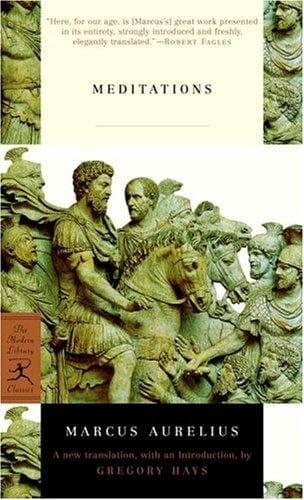
A Roman emperor's private notebook, never meant for our eyes — its one stubborn argument is that you control nothing but your own mind, and that turns out to be enough.
The big idea
Meditations is not a book Marcus Aurelius wrote for anyone; it is the private journal of the most powerful man in the world, scribbled to himself in Greek by lamplight in military camps along the Danube during the Marcomannic Wars. The original had no title we would recognize — scholars call it roughly To Himself — and its twelve short books read like a man arguing himself back to calm, again and again. The philosophy is Stoicism, inherited above all from the former slave Epictetus, whose Discourses Marcus had been lent by his teacher Junius Rusticus.
The pain of any event lives in your judgment of it — and judgment is the one thing you can revoke.
Picture the setting of the book most people never picture: not a study in Rome but a tent on the northern frontier, sometime in the 170s AD, an emperor in his fifties writing by lamplight between campaigns against the Germanic tribes. Marcus Aurelius was not composing for readers. He was talking to himself — drilling reminders, catching his own mind drifting toward fear or anger, and steering it back. The notebook had no audience and, as far as he knew, no future.
The obstacle is the way: what stands in the path becomes the path.
Marcus's reign was an almost unbroken run of catastrophe. The Antonine Plague swept the empire from 165 AD, at its height reportedly killing thousands in Rome each day. The frontier was at near-constant war. In 175 AD a trusted general, Avidius Cassius, declared himself emperor on a false rumor that Marcus had died. A lesser man would have read all this as cursed luck. Marcus read it as material.
You could leave life right now — let that govern what you do, say, and think.
Death was not an abstraction to Marcus; it was the weather. He wrote while plague moved through the legions, while men died around him on the Danube, and while his own body — he ate little and was frequently unwell — reminded him daily that he was mortal. So he made mortality a tool. Rather than flinch from it, he kept it in view as the thing that clarifies what actually matters.
Stop debating what a good person is. Be one.
The first of the twelve books is unlike anything that follows. Instead of philosophy, it is a long ledger of gratitude — Marcus naming, one by one, the people who shaped him and the specific thing each gave him. From his grandfather, good manners; from Rusticus, the loan of Epictetus and the habit of plain writing; and above all from his adoptive father, the emperor Antoninus Pius, a model of mildness, hard work, and steadiness under power. Marcus grounds his ethics not in theory but in debts owed to real people.
Expect difficult people — and refuse to become like them.
The second book opens with the most quoted morning routine in philosophy. Before the day begins, Marcus braces himself: he tells himself he will meet meddlers, ingrates, the arrogant, the dishonest, the jealous and the surly. He does it not to breed contempt but to remove surprise — and to remember that such people act out of ignorance of what is truly good and bad, that they are kin to him, and that they cannot truly harm him unless he lets them drag him down to their level.
The takeaway
Marcus Aurelius never meant to teach us anything — Meditations is a powerful man talking himself off a ledge, over and over, which is exactly why it still works. Its gift is a single durable lever: you cannot control what happens, only the judgment you attach to it, and that judgment is always yours to revise. Read it as what it is — not a system to admire but a practice to repeat, on the ordinary bad mornings when nothing has gone wrong yet except your own mind.