Nonviolent Communication
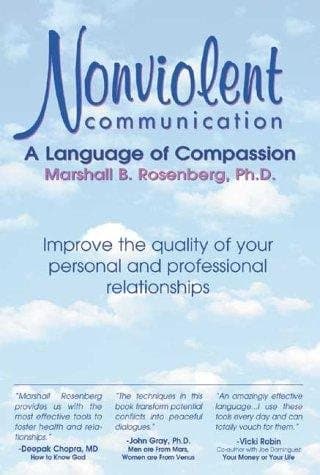
A four-step framework for saying hard things without breaking the connection.
The big idea
Rosenberg's NVC method asks four things in any tense conversation: observe without judgment, name your feeling, identify the underlying need, and make a clear request. The framework reveals how often we communicate evaluations as if they were facts ('you always…') and demands as if they were requests. Practiced, it can defuse arguments, deepen empathy, and replace blame with shared problem-solving.
Four steps: observation, feeling, need, request — in that order, every time.
Marshall Rosenberg developed the four-step framework while mediating school desegregation conflicts in 1960s Atlanta and Detroit. A student of Carl Rogers at the University of Wisconsin, he brought Rogers' empathic-listening research into combustible school-board meetings. He noticed the same words landed differently depending on the order: observation, feeling, need, request. Skip a step and the listener's defenses snap closed.
Observations describe; evaluations judge. Confusing them is the source of most conflict.
“Observing without evaluating is the highest form of human intelligence.”Feelings come from unmet needs, not from what others did or said.
Rosenberg's reframe: when someone says 'you make me angry,' they're handing the other person all the emotional power. NVC reroutes: 'I feel angry because I have a need for fairness that isn't being met.' The need is yours; the trigger is theirs; only by separating them can you actually communicate something useful. He provides extensive feeling/needs lists at the back of the book to support the practice.
Requests are specific, doable, and present-tense — and may be declined.
Rosenberg distinguishes requests from demands: a request invites a yes or no, while a demand punishes a no. Vague requests ('be more respectful') don't tell the other person what to actually do; specific requests ('would you be willing to put your phone away during dinner this week') do. If you can't accept a no, you're making a demand, not a request, regardless of grammar.
Listen for the need beneath the words — anger usually masks unmet care or respect.
Rosenberg recounts mediating between feuding tribes in northern Nigeria in the 1990s, where 100 people had been killed in inter-tribal violence the previous year. A man in the room shouted at him: 'You murderer!' Instead of defending, Rosenberg asked: 'Are you furious because you have a need for safety for your children?' The man wept and started talking. The shouted accusation was the surface; the unmet need beneath it was the actual conversation.
Self-empathy first: you can't extend what you can't give yourself.
Rosenberg argues practicing NVC starts inward: when you catch yourself in self-judgment ('I'm so stupid for forgetting'), translate it into the four steps for yourself ('when I notice I forgot the meeting, I feel embarrassed, because I need reliability'). The same compassion you offer others must be available to you, or you'll borrow against an empty account.
'Should' is a violence word — replace it with 'could' or 'choose to.'
Rosenberg traced the word 'should' to what he called 'amtssprache' — the German bureaucratic language Adolf Eichmann claimed at his Nuremberg trial made his crimes feel impersonal. 'I had to.' 'It was required.' Less dramatically, the same grammar runs through office life and family kitchens: 'you should know better,' 'I should be over this by now.' Every 'should' hides a choice and a value.
The takeaway
Rosenberg's gift is a four-step grammar — observation, feeling, need, request — for saying hard things without breaking the connection. Through the Nigerian elder shouting 'murderer!' and the prisoner who broke down at being asked if he'd needed to be seen as a child, you learn that beneath every accusation is an unmet need waiting to be heard. You leave catching the 'shoulds' and 'always' in your own speech, translating jackal language into giraffe before it leaves your mouth.