Quiet
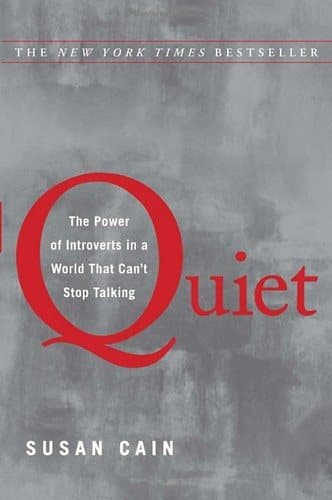
The world we've built rewards extroverts — and quietly underuses half its talent.
The big idea
Cain examines the 'extrovert ideal' — the cultural assumption that the bold, the brash, and the verbal are inherently more capable. Drawing on neuroscience and history, she shows how introverts (a third to a half of the population) think differently, lead differently, and create differently — and how schools, offices, and meetings systematically silence them. The book is a quiet manifesto for designing environments where introverts can thrive.
Introversion isn't shyness — it's a preference for low-stimulation environments to think.
Susan Cain draws the distinction sharply: shyness is fear of social judgment; introversion is a neurological preference for less stimulation. Many introverts aren't shy at all — they simply lose energy in highly stimulating environments and recharge in quiet. Cain herself, a former Wall Street lawyer, is one. She profiles colleagues who could deliver complex closing arguments in court and then collapse in their offices needing two hours of silence.
Open offices and brainstorming meetings often produce worse work than solitude.
“Most inventors and engineers I've met are like me—they're shy and they live in their heads. They're almost like artists. In fact, the very best of them are artists. And artists work best alone where they can control an invention's design without a lot of other people designing it for marketing or some other committee. I'm going to give you some advice that might be hard to take. That advice is: Work alone.”Solitude is a catalyst for innovation; collaboration without it tends toward groupthink.
Cain visits Anders Ericsson at Florida State University and watches his interview protocols with elite performers — pianists, dart players, chess grandmasters. The shared variable across nearly all of them was solitary deliberate practice averaging four hours per day, with most performers describing solitude as their secret ingredient. Ericsson's data on 10,000-hour expertise development consistently shows it accumulates alone, not in groups.
Introverts make excellent leaders, especially of proactive teams.
Cain spotlights Adam Grant's Wharton research from 2010, which ran controlled experiments at a pizza-chain franchise across 130 stores. When teams were proactive (employees full of suggestions), introverted managers' stores outperformed extroverted managers' by 14% — the introverts listened, implemented suggestions, and gave credit. When teams were passive, the order reversed.
Public speaking can be performed; it doesn't require becoming an extrovert.
Cain herself, a self-described introvert, gave a TED talk in February 2012 that has now been viewed over 30 million times. She describes preparing for over a year — sixty hours of solitary rehearsal, two days of complete silence beforehand, and a week of quiet recovery after. The performance was extreme effort; the recovery was the price.
The 'restorative niche' — time alone — is necessary fuel, not a luxury.
Cain borrows the term from psychologist Brian Little. After a stretch of social demand — meetings, parties, performance — introverts need solitude the way a phone needs a charger. Without it, they grow irritable, foggy, and resentful. She describes Little's own habit of locking himself in a stall between Harvard lectures to recharge for ten minutes before facing the next class of 200 students.
Pair complementary types: introverts with extroverts often outperform either alone.
Cain devotes a full chapter to the partnership between Rosa Parks and Martin Luther King Jr. Parks, by all accounts an introvert who described herself as quiet and reserved, refused to give up her bus seat on December 1, 1955 — the act that ignited the Montgomery Bus Boycott. She insisted on King, then a 26-year-old preacher, as the boycott's spokesperson because she knew his oratory could carry what her quiet defiance had ignited.
The takeaway
Cain's gift is permission. After watching Wozniak design the Apple I alone in a cubicle from 10pm to 3am, and Rosa Parks refuse to move so King could speak, you stop apologizing for needing solitude and stop confusing volume with capacity. You leave designing your work and home around restorative niches instead of performing extroversion, and pairing complementary types deliberately — because the quiet ones aren't broken loud people, they're half the talent the room is built to silence.