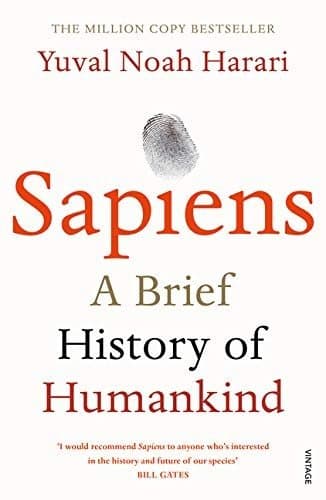
Sapiens: A Brief History of Humankind
Homo sapiens conquered the planet not by being stronger or smarter — but by telling stories strangers could believe together.
The big idea
Yuval Noah Harari traces seventy thousand years of Homo sapiens from a marginal African ape to the master of Earth. He argues that what set our species apart wasn't bigger brains or sharper tools, but a peculiar talent — imagining things that don't physically exist (gods, nations, corporations, money) and convincing millions of strangers to believe in the same fictions. He calls this the Cognitive Revolution.
Cognitive Revolution: fictions are what let strangers cooperate at scale.
Harari opens with a thought experiment. Two chimpanzees can cooperate. Two thousand cannot. Even a hundred chimps in a forest is too many — they fall into chaos and infighting within hours. Yet a Catholic mass can hold ten thousand strangers together, all murmuring the same words about a man from Galilee two thousand years ago. What changed?
The Agricultural Revolution was a trap — wheat domesticated us.
For two and a half million years, hominids lived as foragers. They walked into a forest, picked berries, hunted gazelles, slept where they wanted. Their diet was wide. Their hours were short. Then somewhere around 9500 BC, in the hills of what is now southeastern Turkey, someone started planting wheat on purpose.
Money and corporations are shared fictions that work because we all keep believing.
Harari uses the French car company Peugeot as a teaching example. Peugeot SA owns factories, has bank accounts, signs contracts, and can be sued in court. But where is Peugeot, exactly? Not in Armand Peugeot the founder, who died in 1915. Not in any single factory, which can be sold without ending the company. Peugeot exists because French law, French courts, and French citizens all agree it exists.
Imagined orders feel like nature — that is what makes them dangerous and durable.
Hammurabi's Code, carved on a black diorite stele around 1776 BC, opens with the gods Anu, Enlil, and Marduk appointing Hammurabi to make justice prevail in the land. It then prescribes that if a superior man kills a commoner's daughter, he pays thirty shekels of silver. If she is the daughter of a slave, twenty. The hierarchy is baked into the punishment.
The Scientific Revolution began with the words 'we don't know.'
For most of recorded history, when a scholar wanted to know something he opened an old book — the Bible, the Quran, Aristotle, the Vedas. The assumption was that important knowledge had already been discovered by ancestors or revealed by gods. New ideas came in the form of better commentary on old texts, not fresh investigation.
The takeaway
Harari's gift is a kind of vertigo — the realization that nearly every load-bearing structure in modern life (money, nations, careers, laws) is a story we keep retelling each other. The book does not ask you to abandon those stories. It asks you to notice you are inside one, and to choose which fictions are worth your belief and which are quietly costing you.