Switch
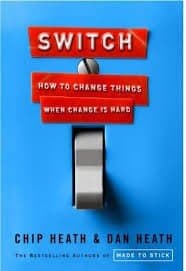
Lasting change isn't about willpower — it's about directing the Rider, motivating the Elephant, and shaping the Path.
The big idea
Chip and Dan Heath argue that every change problem — personal or organizational — is a conflict between three actors: the rational Rider, the emotional Elephant, and the situational Path. The Rider/Elephant metaphor is borrowed from social psychologist Jonathan Haidt; the operating manual is the brothers' own.
Every change problem is three problems: the Rider, the Elephant, and the Path.
The Heath brothers borrowed their central metaphor from social psychologist Jonathan Haidt, who in The Happiness Hypothesis described the human mind as a small rider perched on a large elephant. The Rider is the conscious, planning, analytical mind; the Elephant is the automatic, emotional, instinctive mind. Haidt's claim was that the Rider holds the reins, but the Elephant decides where to go. Chip and Dan Heath added a third element — the Path — and turned a metaphor into a diagnostic tool.
Find the bright spots — what's working is more useful than what's broken.
In December 1990, Save the Children sent Jerry Sternin to Vietnam with a six-month visa, a thousand dollars, and a brief to fix childhood malnutrition. Sternin arrived in Hanoi as one of the first Westerners allowed into the country since the war; the foreign minister told him he had six months and was not welcome to stay longer. The conventional analysis was already complete — Vietnamese children were malnourished because of poverty, poor sanitation, and lack of clean water. Sternin called this kind of analysis TBU: true but useless. Knowing the structural causes did not tell anyone what to do on Tuesday.
Script the critical moves — ambiguity, not resistance, is what kills change.
In the early 2000s, public-health researcher Steve Booth-Butterfield was hired to reduce saturated-fat consumption in West Virginia, a state with some of the highest cardiovascular-disease rates in the country. The brief from the funder was the standard 'encourage healthier dairy choices' — the kind of vague guidance that lets a Rider analyze for years without ever changing a behavior. Booth-Butterfield refused the brief and rewrote it. The campaign would not promote 'low-fat dairy' in the abstract. It would promote one specific switch: from whole milk to 1% milk.
Shrink the change — the Elephant moves when the goal feels close enough to reach.
In 2004, Donald Berwick, a Harvard pediatrician who ran the Institute for Healthcare Improvement, gave one of the most consequential speeches in modern healthcare. American hospitals were killing roughly 100,000 patients a year through preventable medical errors — bad handoffs, missed infections, drug interactions, wrong-side surgeries. Berwick proposed that the country could save 100,000 lives in eighteen months. He was not asking for new funding; he was asking hospitals to adopt six specific protocols already validated in published research.
Tweak the Path — what looks like a people problem is almost always a situation problem.
The Heath brothers introduce the Path with an experiment by social psychologists John Darley and Daniel Batson at Princeton in 1973. Seminary students were told they were running late to deliver a sermon — on the Good Samaritan parable — across campus. On their way, the experimenters had placed a man slumped in a doorway, coughing and groaning. Of the students who weren't told they were behind schedule, sixty-three percent stopped to help. Of the students told they were running late, ten percent stopped. The variable that mattered was not the person's character. It was the situation.
The takeaway
The Heaths' gift is the diagnostic discipline of three actors. When change stalls, you stop asking why people are resistant and start asking which actor is failing — is the Rider unclear, the Elephant exhausted, or the Path designed against us? Jerry Sternin's answer in Vietnam was the bright spots already in the rice paddies; Steve Booth-Butterfield's was 'switch to 1% milk' instead of 'eat better.' You leave with one sharper habit: before blaming the person, fix the situation.