Talking to Strangers
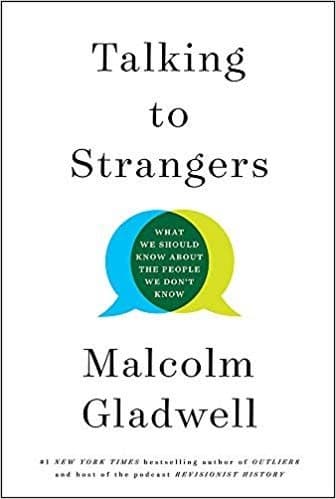
We assume we can read the people we don't know — their faces, their lies, their intentions — and Gladwell shows how often, and how catastrophically, we're wrong.
The big idea
Malcolm Gladwell opens and closes with Sandra Bland, the Black woman pulled over for a missed turn signal in rural Texas in 2015 and found dead in a jail cell three days later, and uses her death to ask a larger question: why are we so bad at making sense of strangers? His answer rests on three flawed tools. First, we 'default to truth' — we assume people are honest, which is why CIA officers missed the Cuban double agent Ana Montes and the SEC ignored Harry Markopolos's warnings about Bernie Madoff for years.
We default to truth: our brains assume honesty until the doubts pile too high to ignore.
For sixteen years Ana Belen Montes was the U.S. Defense Intelligence Agency's senior analyst on Cuba — and the whole time she was spying for Havana, memorizing classified material and typing it up at home. A colleague named Reg Brown grew suspicious and flagged her. Investigators looked, found her plausible, and moved on. She was finally arrested only in 2001, after a separate lead forced the issue. The people closest to her, the trained intelligence professionals, were the ones who kept giving her the benefit of the doubt.
The transparency myth: we believe faces are windows, and they routinely deceive us.
In November 2007, in Perugia, Italy, British student Meredith Kercher was murdered, and suspicion fell on her American flatmate, Amanda Knox. Knox hadn't killed anyone — there was no physical evidence tying her to the scene, and another man's DNA was all over it. But she behaved strangely: she did cartwheels at the police station, kissed her boyfriend outside the crime scene, bought underwear the next day. Investigators read the mismatch between her demeanor and their expectations as guilt, and she spent four years in prison before Italy's highest court cleared her in 2015.
Behavior is coupled to context: pull an act out of its place and you misread the person.
On a freezing February morning in 1963, the poet Sylvia Plath sealed the kitchen of her London flat with wet towels, laid out bread and milk for her sleeping children, and put her head in the gas oven. For decades her death was explained entirely by her depression. Gladwell asks a different question — why the oven? At the time, British homes ran on 'town gas' made from coal, thick with carbon monoxide. It was lethal, painless, and right there in every kitchen.
Meeting in person can make you worse at reading someone, not better.
In September 1938, with Europe sliding toward war, British Prime Minister Neville Chamberlain boarded a plane for the first time in his life to fly to Germany and meet Adolf Hitler face-to-face. He met him three times in two weeks — at Berchtesgaden, at Godesberg, and finally at Munich. Chamberlain was convinced that by sitting across from the man and studying him, he could gauge whether Hitler's promises could be trusted.
Sandra Bland is what happens when all three failures collide on a quiet road.
On July 10, 2015, Sandra Bland was driving through Prairie View, Texas, when she moved over to let a state trooper's cruiser pass — and was pulled over for failing to signal the lane change. Officer Brian Encinia approached, noticed she seemed irritated, and asked her to put out her cigarette. The stop escalated within minutes into a shouting confrontation, a threat with a stun gun, and an arrest. Three days later, Bland was found dead in her jail cell.
The takeaway
Gladwell's gift is to make our confidence feel suspicious. We are built to trust, to read faces, and to judge people apart from their circumstances — and each of those instincts, useful as it is, quietly betrays us with the people we know least. What we carry away is not a lie-detector trick but a discipline: hold our certainty loosely, look at the stranger's world before the stranger's face, and approach the people we don't know with caution and humility.