The 48 Laws of Power
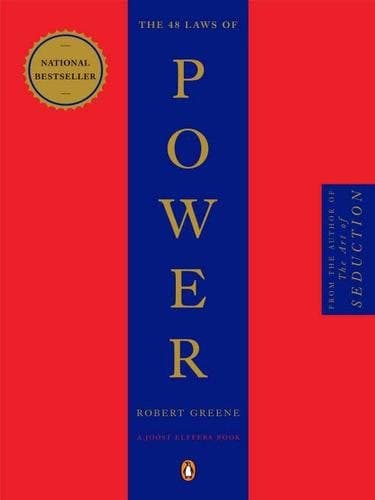
A 1998 distillation of three millennia of court intrigue — forty-eight cold-eyed rules for operating where power actually lives.
The big idea
Robert Greene spent years inside Sun Tzu, Machiavelli, Schopenhauer, and the memoirs of courtiers, generals, and con artists, then compressed three millennia of power tactics into forty-eight laws. Each follows a four-part structure: a one-line dictum, a brief judgement explaining the logic, a transgression (a historical figure who broke the law and paid for it), and an observance (someone who followed it and won). The cast is exhaustive — Louis XIV's finance minister Nicolas Fouquet ruined by a single ostentatious party in 1661, Talleyrand surviving five French regimes by serving each ruler's vanity, P. T.
Law 1: Never outshine the master — make those above you feel comfortably superior.
August 17, 1661, Vaux-le-Vicomte, the new château of Nicolas Fouquet, finance minister to the young Louis XIV. Fouquet had spent years of state revenue building it — Le Vau as architect, Le Nôtre on the gardens, Le Brun on the ceilings. That evening he threw a party for the king. Molière premiered a new play, Lully composed original music, custom-engineered fountains played the gardens, and the fireworks closed with the king's monogram in the sky.
Law 3: Conceal your intentions — let the opponent guess wrong while you act.
Charles-Maurice de Talleyrand-Périgord was the most consequential French diplomat of his era, and his career was a master class in survival through ambiguity. Born in 1754, he was made Bishop of Autun by Louis XVI, served the Revolution that toppled the king, became Napoleon's foreign minister, helped engineer the Bourbon Restoration after Napoleon fell, and remained influential under Louis-Philippe. Five regimes. Each one assumed he was theirs.
Law 6: Court attention at all cost — being talked about beats being judged on merit.
In August 1835, a twenty-five-year-old shopkeeper from Connecticut named P. T. Barnum paid one thousand dollars for the rights to exhibit Joice Heth, an elderly Black woman whom her previous owner claimed had been the nurse of the infant George Washington. The claim made her, by 1835, supposedly 161 years old. Barnum knew the story was almost certainly false. He didn't care.
Law 28: Enter action with boldness — half-measures invite the resistance whole measures avoid.
April 1519, the coast of Mexico near present-day Veracruz. Hernán Cortés had landed with about six hundred men, sixteen horses, and a handful of small cannon to take on the Aztec Empire — population estimated at five million, capital city of Tenochtitlán a fortified island with a hundred thousand inhabitants. The numerical imbalance was roughly ten thousand to one. Many of his soldiers wanted to turn back.
Law 48: Assume formlessness — the operator with no fixed shape cannot be targeted.
Greene closes his book with the most demanding law and the one with the deepest roots. The image he keeps returning to is water — Sun Tzu's central metaphor in The Art of War, written around 500 BCE. Water has no shape of its own. It takes the form of its container. It can wear down stone. An army that fixes its formation can be predicted, flanked, and broken. An army that moves like water cannot.
The takeaway
Greene's gift is a flat, unflinching look at how power actually moves — not how we wish it moved. The forty-eight laws are not prescriptions to follow blindly but a vocabulary for naming the moves already being made around you: by your boss, your rival, the institution you serve. Read this way, the book turns spectators into operators — not necessarily into Machiavellians, but into people who can no longer be played without noticing it.