The Culture Code
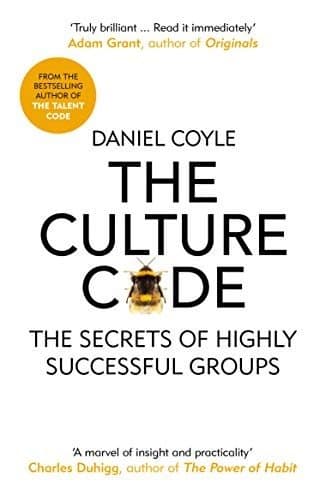
Great teams aren't built from talent or chemistry — they're built from belonging, vulnerability, and purpose, signaled in a thousand small moments.
The big idea
Coyle set out to answer a deceptively simple question: why do some groups add up to more than the sum of their parts? After embedding with the San Antonio Spurs, Pixar, Navy SEAL Team Six, and even a band of jewel thieves, he concluded that culture is not a mysterious trait but a set of learnable skills. Strong groups run on three of them: they build safety through constant belonging cues, they share vulnerability so members learn to trust and depend on one another, and they establish purpose through vivid stories and catchphrases that point toward a shared future.
Culture isn't who a group is — it's a set of behaviors you can build, starting with safety.
In the early 2000s a young business-school researcher named Will Felps designed an experiment around a single question: how does one bad apple affect a group? He recruited a charismatic actor — call him Nick — and embedded him in dozens of four-person teams asked to solve a management problem. Nick played one of three negative archetypes: the Jerk (aggressive and defiant), the Slacker (withholding effort), or the Downer (gloomy, 'this is never going to work'). Across the board, Nick's presence dragged team performance down 30 to 40 percent.
Belonging is fed by hundreds of tiny signals, not one grand gesture.
The designer Peter Skillman ran a deceptively simple contest. Teams of four get twenty sticks of spaghetti, a yard of tape, a yard of string, and one marshmallow, and eighteen minutes to build the tallest free-standing tower with the marshmallow on top. Business-school students attacked it strategically — discussing, planning, quietly jockeying over who would lead. Kindergartners barely talked at all. They stood shoulder to shoulder, grabbed materials, tried things, and failed fast together.
Vulnerability comes before trust, not after — admitting you need help is how groups bond.
Jeff Polzer, a professor of organizational behavior at Harvard, studies a moment most of us instinctively avoid: the instant a person admits they don't know something. Conventional wisdom says trust must come first and only then will people open up. Polzer's research shows the reverse. A small signal of vulnerability — 'I screwed that up,' 'I need help,' 'can you teach me?' — invites a matching signal in return, and that exchange builds trust faster than any amount of getting-to-know-you.
Leaders go first: the most powerful thing a boss can do is admit they were wrong.
Dave Cooper spent years leading Navy SEAL Team Six, the U.S. military's most elite unit, and became known for building teams that could think clearly under fire. His method was not to project bulletproof confidence. It was the opposite. Cooper deliberately signaled his own fallibility and invited the most junior operators to question him, because a team that defers blindly to its leader is a team that has stopped noticing danger.
Purpose is built with vivid signals and stories that link the present moment to a shared future.
When the restaurateur Danny Meyer opened Union Square Cafe in New York in 1985, he was twenty-seven and had never run a restaurant. What he built became one of the most admired hospitality groups in America, and he did it by relentlessly repeating a single idea he called enlightened hospitality: take care of each other first, then the guest, then the community, then suppliers and investors — in that order. Meyer's staff hear short catchphrases all day: 'Make the charitable assumption.' 'Read the guest.' 'Turn up the home dial.'
The takeaway
Coyle's gift is proving that great culture is not a personality trait or a lucky accident — it's a craft, assembled from belonging cues, shared vulnerability, and vivid purpose that anyone can practice. Once you see Jonathan quietly making a room feel safe, or the All Blacks sweeping their own locker room, the question stops being 'do we have good chemistry?' and becomes 'what small signal can I send right now?' You leave treating culture as a verb.