The Miracle Morning
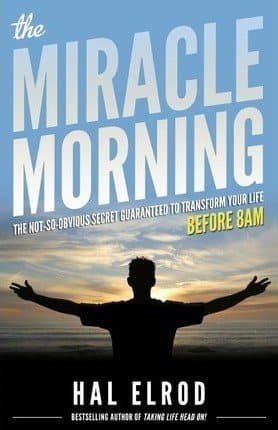
How you start the morning programs the rest of the day.
The big idea
After a near-fatal car accident, Elrod built a morning routine that combined six practices into the acronym SAVERS: Silence, Affirmations, Visualization, Exercise, Reading, Scribing. Each individually is well-known; the value is in the stacking and the early hour, before the world's demands hit. The promise is straightforward: if you upgrade your first hour, you upgrade your day, and stacked days become a different life.
SAVERS: Silence (meditate), Affirmations, Visualization, Exercise, Reading, Scribing (journal).
On December 3, 1999, a drunk driver hit Hal Elrod's Ford Mustang head-on at 70 miles per hour on Highway 99 in Lemoore, California. He was 20 years old, a top sales rep at Cutco. He was clinically dead for six minutes, broke 11 bones, and was told he might never walk again. Six weeks later he walked out of the hospital.
Set the alarm across the room — eliminate the snooze decision entirely.
Elrod's argument starts with a single number: every snooze you hit is a vote for a self that breaks promises to itself. The original word for that vote, he writes, is wakeful intent — and the simplest engineering hack is putting the alarm at least seven feet from the bed so the decision is made by physics, not willpower.
Drink water on waking; rehydration beats caffeine for early alertness.
After 6-8 hours without fluids, the body wakes mildly dehydrated — and even 1-2% dehydration measurably impairs cognition. Elrod prescribes 16-24 ounces immediately, before the kettle, before the phone. The grogginess most people blame on poor sleep is often misread thirst the brain hasn't sorted yet.
Even six minutes — one per practice — beats skipping the routine.
Elrod calls it the Six-Minute Miracle Morning: one minute each of silence, affirmations, visualization, exercise, reading, scribing. It exists for the day the toddler wakes early, the flight is at 5am, the deadline broke last night. Mediocre execution beats no execution because the streak is the asset, not the duration.
Mediocre mornings produce mediocre days, and vice versa.
By 2008 Elrod was 11 months behind on his mortgage, depressed, and watching his Cutco income evaporate as the housing crisis spread. He'd survived the 1999 crash that should have killed him. He couldn't survive a recession, apparently — until he engineered the morning hour. Within six months his income recovered. He attributes the entire turnaround to the first sixty minutes of the day.
Affirmations work when paired with the actions they imply, not as wishful thinking.
Elrod is allergic to Stuart-Smalley affirmations — 'I'm good enough, I'm smart enough.' His version is specific, action-anchored, reason-grounded: 'I am committed to listing ten homes a month because that puts my family in the position we want, and the actions I'm taking today are X, Y, Z.' The structure isn't optional; it's load-bearing.
Read 10 pages a day — 3,650 pages a year, roughly 18 books.
Elrod calls the ten-page daily reading habit the most important he's ever developed. The math is unflinching: 10 pages a day across 365 days is 3,650 pages, and the average non-fiction book runs 200-300 pages. That's roughly 18 books a year. Across a decade, 180 books — putting you in the top fraction of one percent of self-educated humans.
The takeaway
Elrod's gift, forged after being clinically dead for six minutes and then bankrupt eight years later, is the discovery that the first hour programs the next sixteen. SAVERS — silence, affirmations, visualization, exercise, reading, scribing — is less a routine than an engineered chemistry stack that wins the day before the world makes its claims on you. You leave with the alarm seven feet from the bed, water before caffeine, and the conviction that even six minutes protects the identity the streak is building.