The Power of Habit
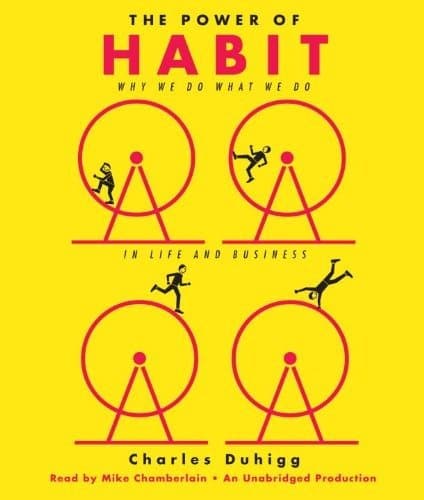
Most of what you do every day is a habit. Find the loop and you can rewrite it.
The big idea
Duhigg, then a New York Times reporter, spent years on the science and stories of habit formation: how a Procter & Gamble researcher saved Febreze, how Tony Dungy built a Super Bowl team, how Alcoa's CEO transformed safety culture. The mechanism is the habit loop: cue → routine → reward. You can't kill an old habit, but you can keep the cue and reward and substitute a new routine. Keystone habits trigger cascades of other change.
The habit loop: cue → routine → reward. Identify each part to change a habit.
Eugene Pauly was a 71-year-old retired aerospace engineer in San Diego when a viral encephalitis attack in 1993 destroyed parts of his medial temporal lobe. He could no longer recognize his wife Beverly's photograph or draw a map to his own house. But every afternoon at 5pm, he walked from his living room to the kitchen, opened the cabinet, and made himself dinner. His habits had survived the brain damage that erased his memories.
Don't try to eliminate a habit; replace its routine while keeping the cue and reward.
Duhigg recounts how Alcoholics Anonymous's twelve steps actually work. Researchers initially couldn't explain AA's effectiveness — the program has no controlled-trial design, no licensed therapists. But the cue (stress, social anxiety, end of work day) and reward (relief, social belonging) stayed the same in members' lives — only the routine changed. Drinking gave way to calling a sponsor, sharing in a meeting, repeating slogans. Same loop, new middle.
Cravings drive habits — the brain learns to anticipate the reward, not just want it.
Procter & Gamble launched Febreze in 1996 as an odor remover. Early results were catastrophic — sales were near zero. Drake Stimson, a P&G researcher, interviewed customers and met a Phoenix housekeeper who described the spritz at the end of cleaning as 'like a little mini-celebration.' The product wasn't actually about removing odors. It was about marking the completion of cleaning. P&G rebuilt the campaign around that moment. Sales doubled within two months and hit $230 million the first year.
Keystone habits — a few foundational ones — cascade change into other areas.
Paul O'Neill took over Alcoa in October 1987 and stunned Wall Street analysts at his first speech: he announced his sole priority was worker safety. Analysts called him a moron and recommended their clients sell. But fixing safety required fixing communication, which fixed quality, which fixed efficiency. By the time O'Neill retired in 1999, Alcoa's market value had quintupled, and the company's worker injury rate had dropped to 1/20th the U.S. average.
Willpower is a learnable skill, finite per day, depleted by decisions.
In 1996, Florida State undergraduates were brought into a lab where freshly baked chocolate-chip cookies cooled on a tray. Half were told to eat the cookies; half were told to resist and eat radishes instead. Both groups were then given an unsolvable geometry puzzle. The cookie-resisters gave up on the puzzle in 8 minutes; the radish-skippers persisted for 19. Roy Baumeister's experiment seemed to prove willpower was a finite muscle that depleted with use.
Belief — usually grown in groups — is what keeps a new habit alive when willpower fails.
Duhigg profiles a man named John, an alcoholic who'd relapsed after multiple solo attempts. He maintained six years sober only after he started showing up nightly to a small church basement AA group in his neighborhood. The community didn't grant him willpower — it carried him during the days his own willpower failed. The same pattern shows up across rehabilitation: the support network is the variable that predicts long-term success.
Organizations have habits too; institutional change starts by mapping their loops.
On November 18, 1987, a small fire in a wooden escalator at London's King's Cross Underground station grew into a flashover that killed 31 people. The official Fennell Report found that no single person had failed — the institutional habit of departmental territorialism had. The ticket inspector who saw the fire wasn't allowed to call the safety inspector who handled escalators. The escalator inspector wasn't allowed to override the station manager. Each waited for someone else to act. By then it was too late.
The takeaway
Duhigg's gift is the diagram inside the autopilot. Once you've followed Eugene Pauly through the kitchen routine that survived his amnesia, watched Febreze succeed by becoming a closing ceremony, and seen Paul O'Neill quintuple Alcoa's value by obsessing over worker safety, you understand habits as a separate operating system with three legible parts: cue, routine, reward. You leave mapping your loops instead of fighting them, replacing routines while keeping the cue, and trusting community to carry belief when willpower runs out.