The Psychology of Money
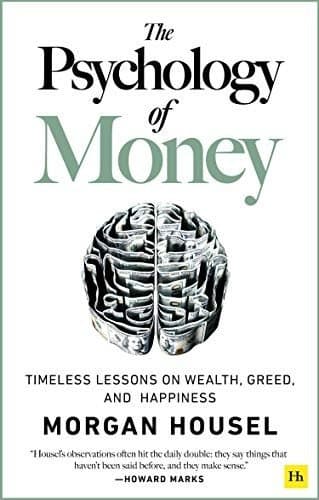
Doing well with money has little to do with how smart you are.
The big idea
Housel argues that financial outcomes are driven less by knowledge and more by behavior — patience, humility, and the ability to avoid disaster. Through nineteen short essays he explains why two people with the same education can end up wildly different financially, why luck and risk matter more than we admit, and why a janitor can outsave a Goldman partner. Tail events, time, and tolerance for boring matter most.
Doing well with money is more about behavior than intelligence.
Ronald Read pumped gas at a Gulf station in Brattleboro, Vermont, and swept floors at JCPenney. He died in 2014 at ninety-two and left $8 million to charity — most of it to the local hospital and library. His neighbors thought him peculiar for cutting his own firewood at ninety. He had quietly bought blue-chip stocks in the 1950s and simply never sold.
Compounding is the eighth wonder; the longest time horizon usually wins.
Warren Buffett's net worth is roughly $100 billion. Of that, $97 billion was accumulated after his sixty-fifth birthday, and ninety-nine percent after his fiftieth. Buffett has been a serious investor since age ten — earning his first money at six selling Coca-Cola door to door. The astonishing fortune is less about return rate than about duration.
Save like a pessimist, invest like an optimist — and never confuse the two.
Housel argues the future is so uncertain that you must save aggressively for short-term shocks while simultaneously believing the long-run trajectory of progress is up. He shows the S&P 500 over the twentieth century — roughly two recessions per decade, two world wars, the Great Depression, the dot-com crash, and the 2008 crisis — and a real return of approximately 17,000x for those who never sold.
Wealth is what you don't see — the cars not bought, the watches not worn.
“Wealth is the nice cars not purchased. The diamonds not bought. The watches not worn, the clothes forgone and the first-class upgrade declined.”Reasonable beats rational — the plan you stick with beats the optimal one you abandon.
Harry Markowitz won the Nobel Prize in 1990 for inventing Modern Portfolio Theory — the mathematical framework for optimal asset allocation. Asked decades later how he had allocated his own retirement, Markowitz admitted he had split it 50/50 between stocks and bonds. Not the math-optimal allocation. The one that let him sleep.
Room for error is the only edge against an unknowable future.
In 1995, Bill Gates told a Microsoft analyst that he kept enough cash on hand to run the company for a full year with no revenue at all — a margin most CEOs would call insane. Gates wasn't pessimistic; he was honest about how much he didn't know. The buffer was not lost return; it was bought survival.
Define enough early — without it, even success won't feel like enough.
Rajat Gupta was the first foreign-born managing director of McKinsey, sat on the boards of Goldman Sachs and Procter & Gamble, and had a personal fortune above $100 million. In 2012 he was convicted of insider trading — passing tips to hedge fund manager Raj Rajaratnam that earned him another $10 million he didn't need. He went to federal prison.
The takeaway
Housel's gift is showing that finance is the rare field where Ronald Read the gas-station attendant outperforms Richard Fuscone the Harvard MBA, because the variable is behavior, not knowledge. Wealth is the cars not bought, time horizon is the multiplier no skill replaces, and Markowitz himself split his retirement 50/50 because reasonable beats rational every decade. You leave saving like a pessimist, investing like an optimist, and naming what 'enough' looks like before the goalpost moves again.