Thinking in Bets
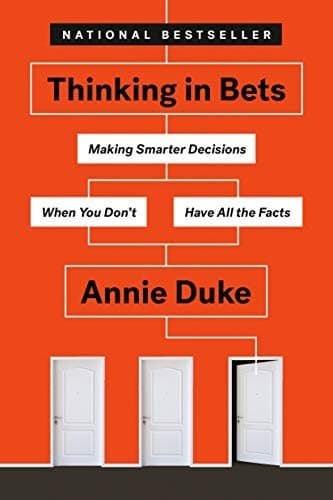
The cards you're dealt are luck — what you do with them is a bet, and good decisions can still lose.
The big idea
Annie Duke spent two decades as a professional poker player after leaving a PhD program in cognitive psychology — and she argues the two careers taught the same lesson. Most decisions, like poker hands, are made with hidden information and a heavy dose of luck, yet we judge them as if life were chess, where every outcome traces cleanly back to a single move. Duke calls this error 'resulting': mistaking the quality of an outcome for the quality of the decision that preceded it.
Resulting: a terrible outcome doesn't prove you made a bad decision.
On February 1, 2015, the Seattle Seahawks were twenty-six seconds from winning Super Bowl XLIX. Trailing the New England Patriots 28-24, they had the ball on the Patriots' one-yard line, second down, with Marshawn Lynch — one of the most punishing short-yardage runners in the league — standing in the backfield. Everyone in the stadium expected a handoff. Instead, coach Pete Carroll called a pass. Russell Wilson's throw was intercepted by an undrafted rookie named Malcolm Butler, and Seattle lost.
Life is poker, not chess: you decide with hidden cards and real luck.
When the mathematician John von Neumann set out to build the field of game theory — formalized in his 1944 book with economist Oskar Morgenstern, Theory of Games and Economic Behavior — he didn't reach for chess as his model. Chess bored him as a template for life. The game he kept returning to was poker, because poker contained the two things he believed real life ran on: incomplete information and deception.
Two forces shape how your life turns out: the quality of your decisions and luck.
Annie Duke did not set out to play cards for a living. She held a National Science Foundation fellowship and was deep into a doctorate in cognitive psychology at the University of Pennsylvania, studying how people learn, when illness forced her to step away just short of finishing her dissertation. Needing money, she took her brother Howard Lederer's suggestion and started playing poker in the bars of Montana.
We believe first and vet later — 'Wanna bet?' is the audit on false certainty.
Descartes assumed we first understand a claim and then, in a separate step, choose whether to believe it. The philosopher Spinoza disagreed: he thought comprehension and belief were the same act — to understand something is, at least for an instant, to accept it. Centuries later the Harvard psychologist Daniel Gilbert ran experiments that settled the dispute in Spinoza's favor, showing that people automatically believe what they hear and only sometimes, with effort, go back to doubt it — and that when they're distracted or tired, the doubting step never arrives.
Say 'I'm not sure' — and state your beliefs as probabilities, not verdicts.
In 1951, a CIA analyst named Sherman Kent helped write a national estimate warning that an attack on Yugoslavia was a 'serious possibility.' Satisfied the language was clear, Kent later asked colleagues what odds they had read into that phrase. The answers ran from twenty percent all the way to eighty. The same three words had meant wildly different things to everyone who read them.
The takeaway
Duke's gift is a working vocabulary for uncertainty — 'resulting,' 'fielding outcomes,' and 'wanna bet?' turn fuzzy intuitions into tools you can actually pick up. Once you stop grading decisions by how they happened to turn out and start grading them by the process behind them, you free yourself to take smart risks — and to forgive yourself for the good bets that simply didn't land.