Tuesdays with Morrie
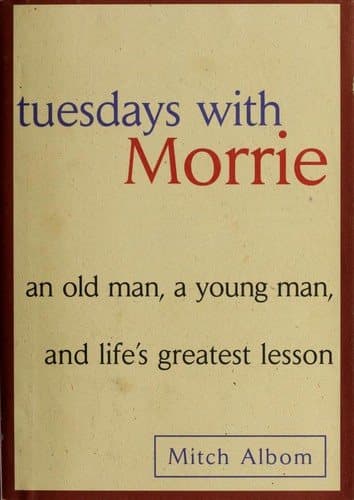
A dying professor and his former student meet every Tuesday — and turn one man's slow goodbye into a final course on how to live.
The big idea
In 1995, sportswriter Mitch Albom saw his old college mentor Morrie Schwartz on Nightline, gaunt with ALS and giving Ted Koppel lessons on dying. He flew to West Newton, Massachusetts, and started visiting Morrie every Tuesday until the disease took him fourteen weeks later. The conversations became a curriculum on regret, family, money, culture, and love — Morrie called it 'a final thesis.' His central claim is that the defaults of late-twentieth-century life — accumulate more, work harder, stay distracted — make people terrible at living and worse at dying.
Rehearse your death and you finally start living: the bird on your shoulder is the only honest mentor.
On the fourth Tuesday, Morrie tells Mitch about a Buddhist practice. Every day, ask the bird on your shoulder: Is today the day? Am I ready? Am I being the person I want to be? Morrie has been running the exercise for months — ever since the neurologist gave him a number for what was left. It sounds morbid until you watch a man who can no longer lift his own arm use it to decide whether the morning is for weeping or laughing.
Love each other or perish: relationships are the only thing on the table when the body leaves.
Auden is everywhere in Morrie's apartment — taped to the refrigerator, scrawled on a yellow legal pad by the bed, repeated to Ted Koppel in front of millions on Nightline. The line he keeps returning to is from 'September 1, 1939,' written when Auden was watching one civilization fall apart and bracing for the next. Morrie says it more often as the disease takes more of him, as if he is filing it away while he still has the breath to file.
Build a small culture and live inside it, because the big one is engineered to keep you unhappy.
Morrie watches very little television, and what he does watch tends to make him angry. He describes the culture around him — late-1990s America, OJ wall-to-wall, market booms, magazine covers about thinner and richer and younger — as a brainwashing operation aimed at keeping people just dissatisfied enough to keep buying. He calls it 'the big lie.' The lie says more is the answer. The lie says young is the answer. The lie says winning is the answer. None of those, he points out, will sit with you on a Tuesday afternoon when you cannot lift your own arm.
Detachment is on the far side of feeling: dive into the emotion, all the way, and only then can you let it go.
On the sixth Tuesday, the topic is emotions, and Morrie introduces what he calls his Buddhist technique — except it is also Jewish, and also, he insists, just human. The instruction runs opposite to what most of his self-improvement-soaked visitors expect to hear. He does not say control your feelings. He says throw yourself completely into them, and only then will they pass cleanly. Resist them, and they will sit in your chest for decades.
Forgive yourself before you die. Then forgive everyone else. And don't wait.
The twelfth Tuesday is about forgiveness, and the story Morrie tells is about Norman. Norman was a close friend from his early Brandeis years — a sculptor who once made a small bust of Morrie. When Charlotte had a serious operation in the 1970s, Norman never called. Morrie was wounded enough that he let the silence harden into a full break. Years later, Norman died of cancer, and Morrie never said the things he had meant to say. Recounting it to Mitch, he cries — not because Norman is dead, but because Morrie did not move first when he still could have.
The takeaway
Albom hands us Morrie Schwartz's last syllabus: dying is the most honest teacher available, and the curriculum it offers — feel everything fully, build a small culture against the loud one, forgive yourself first, choose love because nothing else survives the body — is one we keep refusing only because the alternative is louder. The book's quiet gift is that you do not need a fatal diagnosis to enroll. You only need a Tuesday.