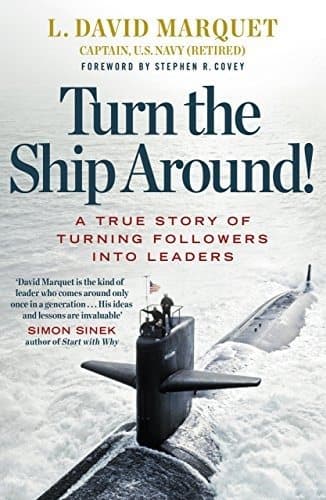
Turn the Ship Around!
Stop giving orders. Replace them with three words: 'I intend to.'
The big idea
Marquet, a U.S. Navy submarine captain, took command of USS Santa Fe in 1999 — at the time the worst-performing submarine in the Pacific Fleet. He had been trained for a different ship, knew almost nothing about Santa Fe's specific systems, and inherited a crew shaped by years of top-down command. Within a year, Santa Fe was rated the best-performing submarine in the fleet, with the highest retention rate in the Navy. Marquet credits a single inflection: he stopped giving orders.
The leader-follower model breaks the moment the leader is wrong — and the leader is sometimes wrong.
In December 1998, Captain David Marquet took command of USS Santa Fe, a Los Angeles-class fast-attack submarine commissioned in 1994. He had spent the previous year preparing to command a different submarine, USS Olympia, and had memorized its systems. Three weeks before he was to take command of Olympia, his orders were changed to Santa Fe — a different class with a different reactor, different combat systems, and a different operating procedure. He had no time to retrain. He took command knowing he was no longer the technical expert on the ship.
'I intend to' is the language of leader-leader — it forces ownership at the lowest level.
Within his first three months, Marquet introduced the linguistic change that became the book's signature. Instead of officers asking permission ('Captain, request permission to submerge the ship'), they would state intent ('Captain, I intend to submerge the ship'). The captain's job was to evaluate the intent and either nod or push back, but the substantive thinking — the analysis of conditions, risks, and options — had already been done by the officer.
Push authority to where the information lives — not pull information to where authority lives.
Marquet identifies the structural problem of any hierarchical organization: information is generated at the bottom — by the sailor on the sonar console, the engineer at the reactor panel — but authority sits at the top. The traditional fix is to push information up: reports, briefings, dashboards, status meetings. The information arrives slower than it was generated, decays in transit, and reaches the authority too late to act on it well.
Resist the urge to provide solutions — it's the most addictive Diminisher behavior in the leader's toolkit.
Marquet describes one of the hardest disciplines of the leader-leader transition: the captain's instinct, when an officer brings him a problem, is to solve it. Decades of training as a Naval officer reward fast, decisive answers. The leader-leader model requires the opposite — the captain has to refuse to solve the problem and instead force it back to the officer, who is closer to it.
Measurable results in twelve months: from worst sub in the Pacific to best — and the metric was retention.
When Marquet took command in December 1998, USS Santa Fe was rated the worst-performing submarine in the Pacific Fleet. Retention was so low that the previous captain had stopped trying to convince sailors to re-enlist. Crew morale was visibly poor; the ship was failing inspections it should have been passing.
The takeaway
Marquet's gift is the smallest linguistic intervention with the largest structural effect: replace 'request permission' with 'I intend to,' and the cognitive work shifts from the captain to the person closest to the situation. Santa Fe went from worst sub in the Pacific to best in twelve months, with retention — sailors voting with their careers — as the verdict. You leave resolved to push authority to where the information lives, refuse to solve problems your team brings you, and create leaders rather than forge followers.