When Breath Becomes Air
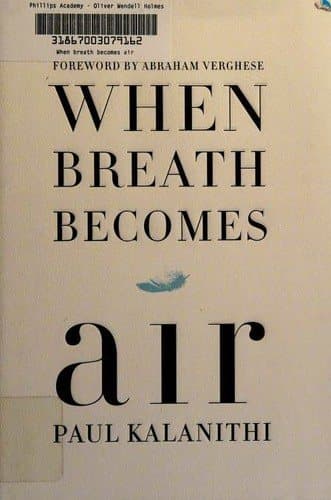
At 36, weeks from finishing neurosurgery residency at Stanford, Paul Kalanithi reads his own CT scan — and turns to face the question of how to die well.
The big idea
Paul Kalanithi spent a decade preparing to be one of the country's most ambitious neurosurgeon-scientists. In May 2013, with two months left in residency at Stanford, he pulled up his own chest CT and saw lungs matted with tumors. When Breath Becomes Air is the memoir he wrote in the twenty-two months between that scan and his death in March 2015 — a literary doctor's account, from the patient's side of the bed, of what makes a finite life worth living.
The doctor crosses to the other side of the bed.
The scene is a CT scan room at Stanford in May 2013. Paul Kalanithi is thirty-six, two months from graduation as a neurosurgeon, and has spent the previous months losing weight and waking at night with a deep, untreatable back pain. He has been telling himself it's the residency — eighty-hour weeks for six years will do that to a spine. On a quiet afternoon between cases he pulls up his own chest images on the hospital workstation and finds himself reading them with the dispassion he has been trained to summon for other people's scans.
Literature was the question; medicine was the answer.
Long before medicine, Paul Kalanithi was a reader. He grew up in Kingman, Arizona, where his mother — worried about the local schools — bought him the College Board's recommended reading list and watched him work through it by flashlight at night. He went to Stanford for English literature, then to Cambridge for a master's in history and philosophy of science, then, finally, to Yale for medical school. Medicine, as he tells it, was not an abandonment of literature. It was the place literature had been pointing him all along.
He went back to the operating room as a dying man.
After the first round of treatment, Paul's tumors shrank. His energy crept back enough that, in the fall of 2013, he asked Emma whether he could return to the operating room. She told him he was the only person who could answer the question. Against the advice of nearly everyone except his wife Lucy, he scrubbed in again and performed brain surgery as a person who knew, in a way he had not known before, what was on the other side.
They chose to have a child anyway.
A few months into the diagnosis, Paul and Lucy started talking about whether to have a child. They had been married since 2006. Lucy was an internist at Stanford. They had postponed children, like many physicians, because of residency. Now there was a different reason to postpone, and this one was final. They went to a fertility clinic in the summer of 2013 and froze embryos. Then they had to decide whether to use them.
The book itself was the last act.
Paul began writing the book seriously after his energy dropped past the line where surgery was possible. He set up a small desk at home and worked in slow, careful bursts between hospital visits. He wore silver compression gloves because chemotherapy had cracked his fingertips. He told his agent in late 2014 that he could finally see the shape of it: a book that began with a young man unsure what his life was for, and ended with a dying man who had finally answered the question.
The takeaway
Kalanithi's gift is the rare clarity of a doctor-turned-patient watching himself live and write at the same time — and writing it down honestly enough that the book becomes a tool for everyone else's eventual reckoning. The argument it leaves is simple and uncomfortable: the time available to anyone is shorter than they think, and having a number attached does not make the question of what to do with it any easier. Do the work that matters now, with the people who matter, while the body still lets you.