Why We Sleep: Unlocking the Power of Sleep and Dreams
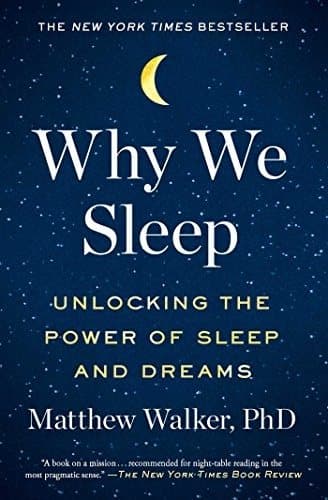
We've been waging an unintentional war on sleep — and our brains, hearts, and waistlines are paying the bill.
The big idea
Matthew Walker, a Berkeley neuroscientist who directs the Center for Human Sleep Science, argues that the modern world has been quietly hostile to the most foundational biological process we have. Drawing on three decades of laboratory experiments, epidemiological data, and clinical trials, he reframes sleep as not a passive luxury but the regulator of memory, emotional balance, immune function, hormonal health, and even genetic expression. The book maps the architecture of NREM and REM cycles, the chemistry of adenosine and melatonin, and the cumulative damage of even modest nightly restriction.
Sleep deprivation impairs you like alcohol — but the workplace cheers it on.
At UC Berkeley's Center for Human Sleep Science, Walker's lab puts drivers through reaction-time simulators after varying degrees of sleep restriction. The findings are blunt: a person awake for seventeen to nineteen hours straight performs on tests of attention and decision-making at roughly the level of someone legally drunk in most U.S. states. Push past twenty hours and the deficits widen further. Worse, participants underestimate their own impairment — they feel a little tired but believe they're functioning normally.
Sleep doesn't erase memory — it sorts, stores, and rehearses it.
Walker's lab runs a clean version of the classic learning experiment. One group of subjects learns a list of word pairs in the evening, then sleeps a full night; another learns the same list in the morning and stays awake through the day. When both are tested at the same elapsed time, the sleep group retains substantially more. The result holds across motor sequences, navigational maps, and emotional faces — sleep is not a memory eraser, it is a memory editor.
Daylight saving time is a global natural experiment — and it kills.
Twice a year, more than a billion people across the Northern Hemisphere have their sleep schedule shifted by an hour, all at once, by government decree. It is the largest sleep experiment on the planet. In the spring, when clocks jump forward and most people lose an hour of sleep opportunity on a single Sunday night, hospitals across the United States and Europe see a measurable spike in heart attacks the following Monday and Tuesday.
Teen brains run on a later clock — and schools punish them for it.
During puberty, the human circadian rhythm shifts forward by one to three hours. Melatonin release — the brain's biological signal for sleep onset — does not begin in an average teenager until roughly ten or eleven at night, and it continues to suppress wakefulness well into the next morning. This is not laziness; it is endocrinology, conserved across mammals and reliably reversing in the early twenties.
Sleep is when the brain literally washes itself.
In 2013, neuroscientist Maiken Nedergaard at the University of Rochester reported a discovery that overturned a century of textbook anatomy: the brain has a dedicated waste-clearance plumbing called the glymphatic system. During deep NREM sleep, cerebrospinal fluid surges through these channels at roughly ten times its waking flow rate, flushing metabolic byproducts out of brain tissue. Awake, the channels constrict and the cleanup nearly stops.
The takeaway
Walker's gift is to turn sleep from background noise into the most leveraged variable in your day. Once you see the data — the drunk-driver cognition, the heart-attack ledger, the brain quietly rinsing itself — eight hours stops looking like indulgence and starts looking like the cheapest medicine ever invented. The work is not to sleep more virtuously; it is to stop apologizing for sleeping at all.