Zero to One
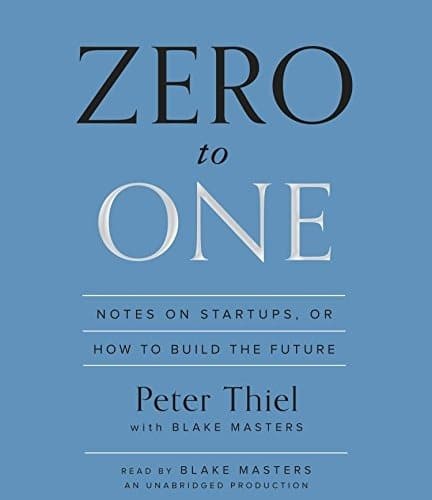
Progress comes not from copying what already works but from building what doesn't yet exist — going from zero to one.
The big idea
Zero to One began as notes a Stanford student named Blake Masters took during Peter Thiel's 2012 class on startups, CS183, which spread across the internet before becoming a book. Thiel — cofounder of PayPal, the first outside investor in Facebook, and a founder of Palantir and Founders Fund — argues that most of what passes for ambition is really imitation: copying proven models to take the world from one to n. Real value, he claims, comes from vertical progress, from creating something genuinely new and going from zero to one.
Vertical progress: the future is made by people who go from zero to one, not one to n.
Thiel opens nearly every encounter — interviews, investments, his Stanford class — with the same disorienting question. He wants to know what important truth a person believes that almost no one around them agrees with. Most people freeze. The easy answers are either things everyone already accepts or things that are merely unpopular but well-known. A real answer requires having thought your way to a conclusion the consensus hasn't reached, and being willing to defend it alone.
Competition is for losers: durable profit comes from monopoly, not from winning a fair fight.
Thiel sets up the chapter with a comparison most people get backwards. Consider the U.S. airline industry — vast, essential, carrying millions of people every day, generating enormous revenue. Yet in 2012, the average one-way domestic fare was around $178, and the airlines made roughly 37 cents in profit on each passenger trip. Now consider Google, which created far less obvious value that year but kept a much larger share of it — over 20 percent of its revenue as profit, more than a hundred times the airlines' margin.
The power law: a tiny number of bets return more than everything else combined.
When Thiel ran Founders Fund, he watched a pattern repeat that defies normal intuition about diversification. In a strong venture fund, a single investment will typically return more money than every other investment in the fund put together. The second-best return will be larger than everything below it. Returns are not evenly distributed; they collapse onto a few outliers. Most companies a fund backs return nothing, and the math of the whole enterprise rests on the rare grand slam.
Secrets: every great company is built on a hidden truth the world hasn't noticed yet.
Thiel divides the world's knowledge into three kinds: conventions everyone agrees on, mysteries no one can solve, and secrets — things that are hard but knowable, true but not yet widely understood. He argues that the modern world has talked itself out of believing in secrets. We assume that anything findable has already been found, that the map is complete, that the only frontiers left are either obvious or impossible. This belief, he says, is a self-fulfilling failure of nerve.
Distribution is half the company: even a brilliant product dies without a way to sell it.
Thiel says engineers and inventors carry a flattering delusion: that a sufficiently good product sells itself, and that paying attention to sales is somehow beneath the work of building. He calls this the bias of people who pride themselves on substance over surface. In reality, the history of technology is full of superior products that lost to inferior ones with better distribution, and full of unremarkable products that won because someone figured out how to get them in front of customers.
The takeaway
Thiel's gift is permission to be contrarian on purpose — to distrust the comfort of competition and the safety of imitation, and to ask instead what valuable thing nobody else is building. He hands the reader a working toolkit for that question: escape rivalry by owning a monopoly, plan around the power law instead of the average, hunt for the secrets the consensus has stopped looking for, and never mistake a great product for a finished business. The deeper lesson is that the future is not something that simply arrives — it is built, deliberately, by the few people willing to think for themselves.